

What to Pack in a Boat Bag: A Dry Bag Guide for Boating and Sailing
Everything on a boat gets wet eventually. Spray over the bow, a line that comes up streaming, a hatch left open for ten minutes in the bad weather. It is rarely a dramatic soaking that spoils the day. It is the slow accumulation of damp that leaves you pulling on a cold fleece three hours from the dock.
A boat bag is the answer to that, but only if you have picked the right one and packed it properly. This guide covers what to carry for a day on the water, how to choose between the main types of dry bag, and how to load one so the weight sits where you want it.
What makes a boat bag different
A backpack that copes perfectly well on a day hike tends to struggle on the water. There are four reasons for that, and they all point the same way.
Salt gets left behind. Fresh water dries and leaves nothing behind. Seawater evaporates and leaves salt deposits that work into zippers, abrade coated fabrics and corrode hardware. The same bag used in salt water has a harder life than one that only sees lakes and rivers.
Spray is constant rather than occasional. On a trail you can shelter from rain or wait it out. On the water the spray arrives sideways, repeatedly, for as long as you are on that heading. Water resistance that handles a rain shower does not handle four hours of that.
Things go over the side. The single most useful feature afloat is whether the bag floats once it is sealed. A bag that sinks takes your gear to the bottom in a matter of seconds, and there is no recovering it.
Nothing stays where you put it. A boat heels, pitches and rolls. A bag needs to wedge into a locker or clip to a rail rather than stand upright on a flat floor, because there is no flat floor.
Start with the right bag
Four shapes cover almost every job on board.
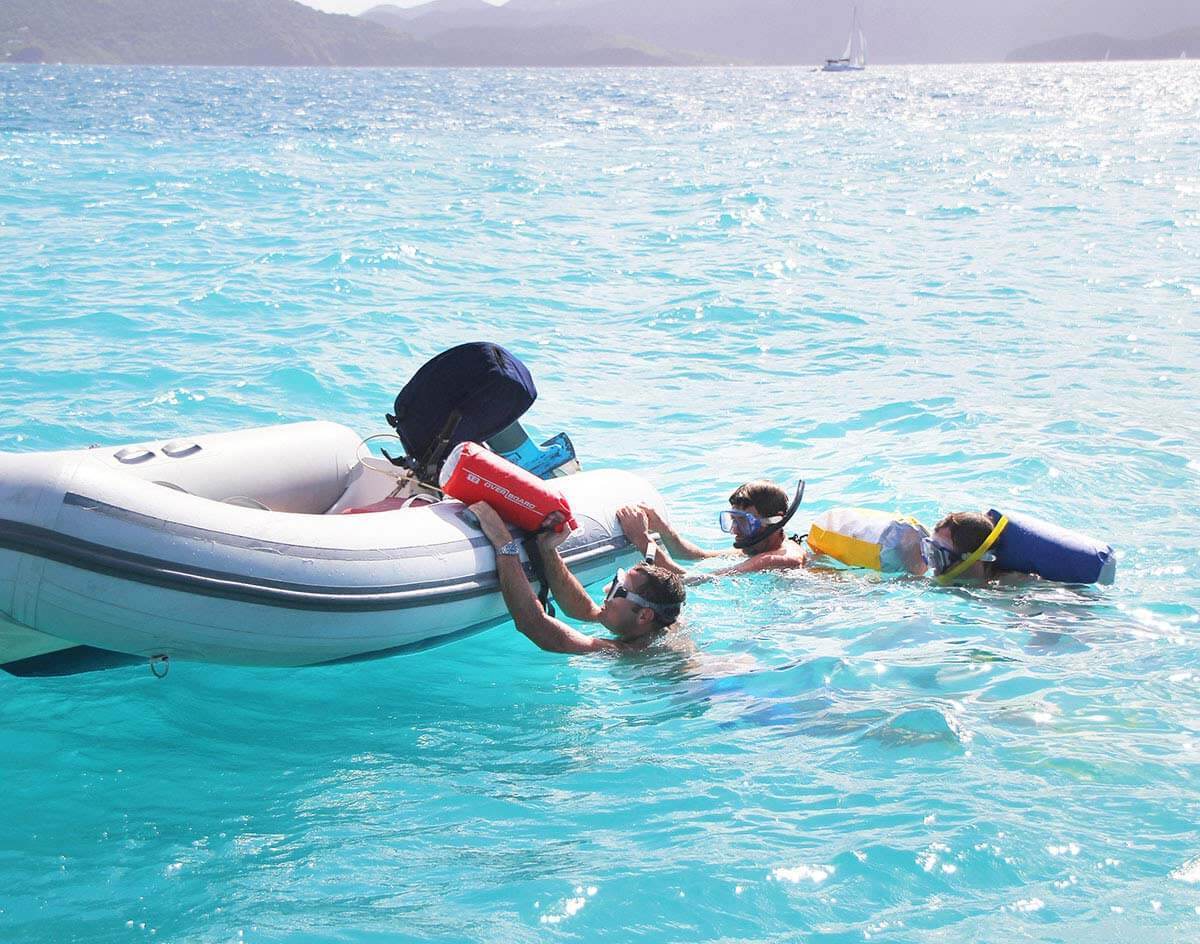
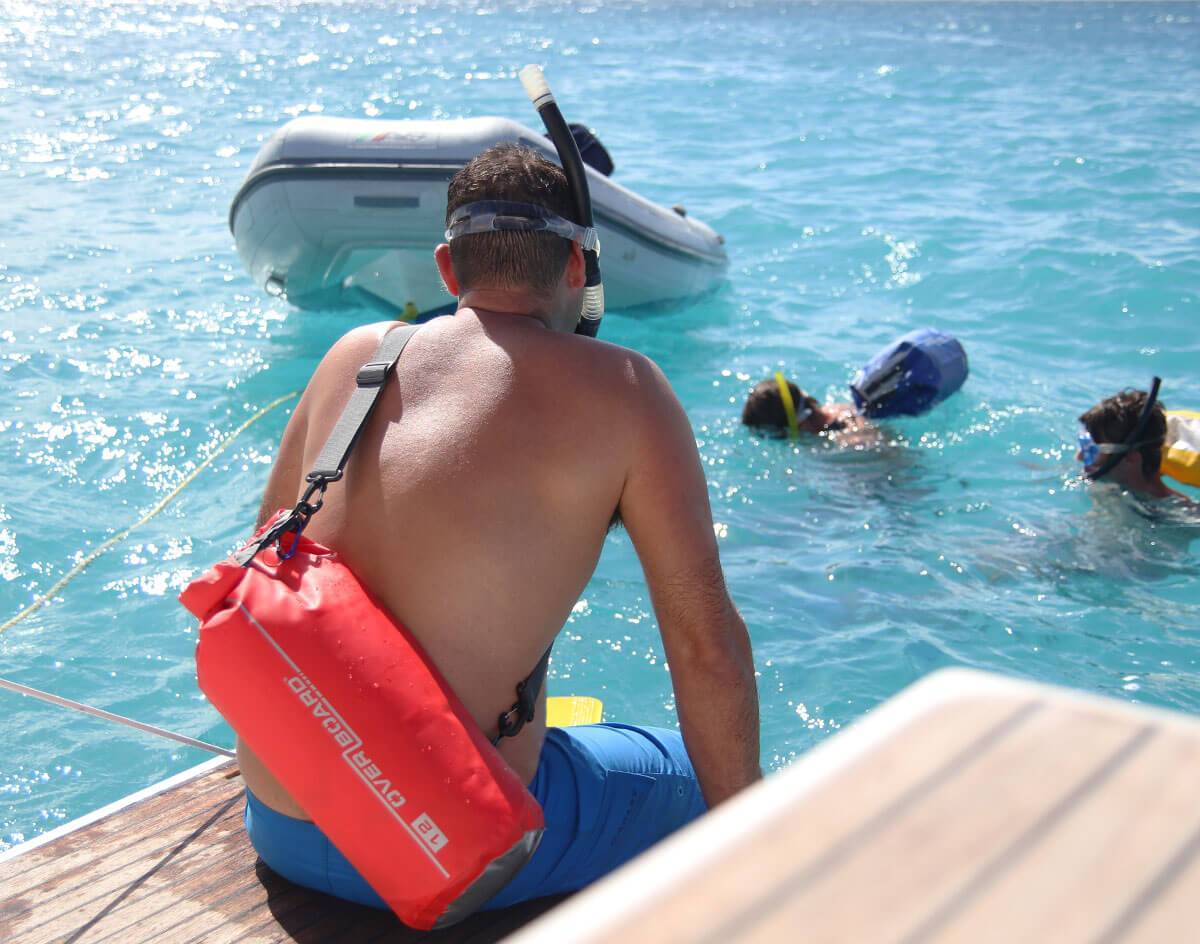
Dry tubes. The cylindrical roll-top bag most people picture when they think of marine dry bags. The 20 Liter Dry Tube is the size most boaters settle on for a day out. It is made from nylon-coated PVC tarpaulin with a toughened, abrasion-resistant base, which matters when the bag spends its life being dragged across non-skid decking. It closes with our Fold Seal System: roll the neck tightly over the fastener three or four times, then clip the top. It floats if it goes over the side, and the shoulder strap is fully removable for when the bag is stowed rather than carried. You can see the full range on our dry tubes page.
Dry flat bags. Shaped to lie down rather than stand up, which suits a locker far better than a tube does. The 15 Liter Dry Flat Bag is made from nylon ripstop with a TPU coating and packs down small when it is empty. Worth carrying as a second bag even if your main one is a tube, because it costs you almost nothing in space. There is a 30 Liter version if you need the extra room.
Deck bags. For the things you want within reach rather than stowed below. The 20 Liter Kayak / SUP Deck Bag is shaped to sit flat and lash down rather than roll around, which makes it useful on a small boat as well as a kayak.
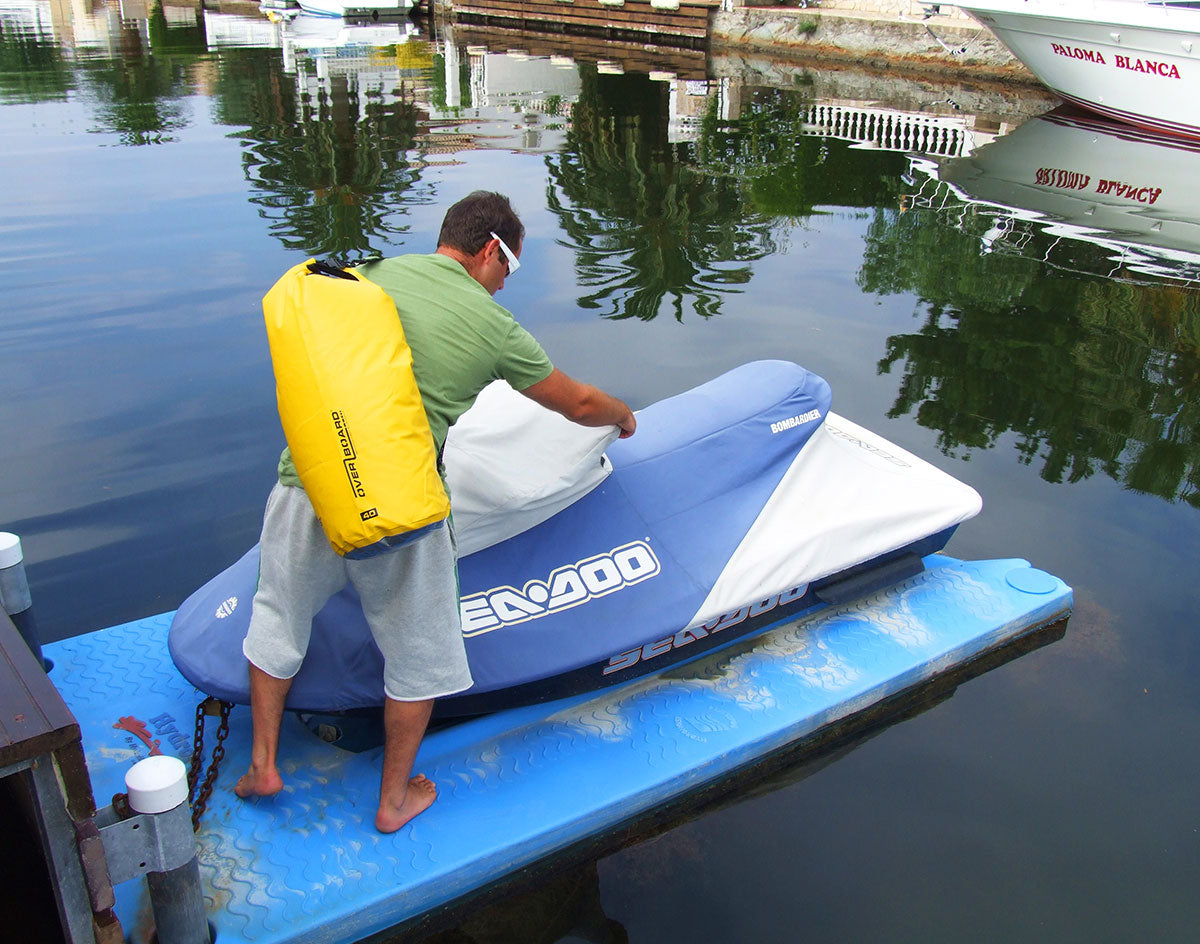
Boat backpacks. A backpack earns its place on the walk down the dock with both hands full. The 60 Liter Backpack Dry Tube adds shoulder straps to a full-size dry tube, which matters more than the extra volume when you are carrying crew gear from the parking lot. Our wider range of waterproof backpacks uses the same roll-top seal and welded seams, so you are not trading protection for the carrying position.
What to pack in a boat bag
This is the core list for a day on the water. Adjust it for how far offshore you are going and how long you expect to be out.
Phone, in a case rather than loose. A phone in the bottom of a dry bag is fine until you need it, at which point you have to unroll the bag in the weather to reach it. A sealed case rated for full submersion keeps the phone usable and on you instead. Our waterproof phone cases use the Slide Seal System and keep the touchscreen working while the case stays closed.
Handheld VHF, sealed and usable. This is the one piece of gear you most need working when something goes wrong, which is also the moment conditions are worst. A dedicated radio case lets you work the push-to-talk, volume and channel controls without opening it, so the radio stays sealed through the whole passage rather than only until the first time you need it.
A full change of clothes, not just a spare shirt. Base layer, mid layer, socks and underwear. Socks are the item people leave out and regret most. Pack them as a sealed unit so that opening the bag for something else does not expose the whole lot.
One more warm layer than you think you need. Wind chill on the water is harsher than the forecast suggests, and the temperature drops as soon as the sun goes behind cloud. A packed fleece takes up very little room.
A first aid kit, sealed and floating. Keep it in its own small dry bag rather than loose in the main one, so it can be grabbed and handed to someone else without unpacking everything. A 5 Liter Dry Tube is about the right size and floats if it goes in.
Food and water for longer than you planned. Tides, engines and weather all have opinions about when you get back. Carry enough for a few extra hours. A 30 Liter Soft Cooler Bag handles the drinks and keeps the melt water off everything else.
Sun protection, including on overcast days. Reflection off the water roughly doubles your exposure, and a gray day offshore burns people who would not burn on land.
A headlamp, and a spare. Anything that takes longer than planned finishes in the dark, and that happens earlier than you expect in fall.
Camera gear, if you are bringing it. A general dry bag protects against water but not against impact. A purpose-built waterproof SLR camera bag adds the padding, which on a boat matters as much as the seal.
Documents and keys. Registration, insurance, car keys and wallet. These want to be in the smallest sealed bag you own, and then inside the main one.
Day trip or overnight: a quick reference
|
Trip |
Bag size |
What goes in |
|---|---|---|
|
A few hours inshore |
5 to 15 liters |
Phone case, keys, one warm layer, snacks and water |
|
Full day on the water |
20 to 30 liters |
Full change of clothes, foul weather layer, lunch, first aid, radio case |
|
Overnight or a weekend |
30 to 60 liters |
Sleeping gear, several days of clothing, wet gear, galley items |
|
Crew gear for a passage |
60 liters or several bags |
All of the above, split so wet gear never shares a bag with dry clothing |
Two medium bags usually beat one large one on a boat. They wedge into lockers that a single large bag will not fit, and you can keep wet gear away from dry clothing without relying on an internal divider.
How to pack it properly
-
Heavy items low and toward the centerline. Weight high up makes a small boat feel livelier than it is, and a bag that shifts when you heel is a bag that ends up somewhere you did not put it.
-
Leave some air in the bag. Buoyancy comes from the air sealed inside, not from the fabric. Pack a dry bag until it is rigid and you have squeezed out the thing that makes it float.
-
Roll the closure three or four times. One or two folds is not a seal, it is a lid. Roll the neck tightly over the fastener, then clip it. This is the step people rush when the weather turns, which is exactly when it matters.
-
Keep wet and dry separate. Foul weather gear and towels in one bag, clothing and electronics in another. Opening one should never expose the other.
-
Clip it to something. A D-ring, a grab rail, or any secure attachment point intended for gear. A sealed bag floats, which is no help at all if it floats away astern while you are busy.
What waterproof rating do you actually need afloat
Our range is rated across five classes, and the difference between them is worth understanding before you buy rather than afterward.
|
Rating |
What it means |
Where it fits on a boat |
|---|---|---|
|
IP64 |
Water resistant for light rain and spray |
Organizing dry gear inside another bag |
|
IP65 |
Foul weather and spray proof |
Quick-access pockets and deck storage |
|
IP66 |
Floats and can handle quick submersion |
Main dry bags, duffels and backpacks |
|
IP67 |
Submersible to depths of up to 3ft / 1m for 30 minutes |
Items that may go under briefly |
|
IP68 |
Submersible to depths of up to 19ft / 6m for 60 minutes |
Phones, VHF radios and electronics |
For most boating the practical answer is IP66 for the bag itself and IP68 for anything electronic inside it. A dry bag is built to keep water out when it goes over the side and is recovered, not to be used underwater. If you want the full detail on what each class covers, our waterproof rating system page sets it out.
Looking after it in salt water
Rinse the bag in fresh water after every trip in salt, including the fastener and the clips. Salt left in a seal is what turns a bag that worked perfectly for two seasons into one that does not.
Dry it open and upside down rather than rolled, and never store it sealed while it is still damp inside. Before each season, run your hand along the welded seams and check the sealing bar is straight. Wear is not always visible, so if a bag is carrying something that matters, test it with a dry towel sealed inside before you rely on it.
Putting your gear together
For a typical day on the water, a 20 liter dry tube, a sealed phone case and a small dry bag for first aid cover almost everything. Add a flat bag for the locker and a cooler for the drinks, and you have a setup that works from a summer afternoon through to a fall passage.
You can see the full range on our waterproof boat bags collection, and the complete selection of sizes and shapes on our dry bags page. If you are heading out under paddle rather than sail, our paddle sports collection covers the gear built for it.
Every OverBoard product can be covered by our 5-year extended warranty when you register it within 90 days of purchase, and US orders over $150 ship free.